
Microneedling vs. Chemical Peels: Which Is Better for Acne Scars in Austin?
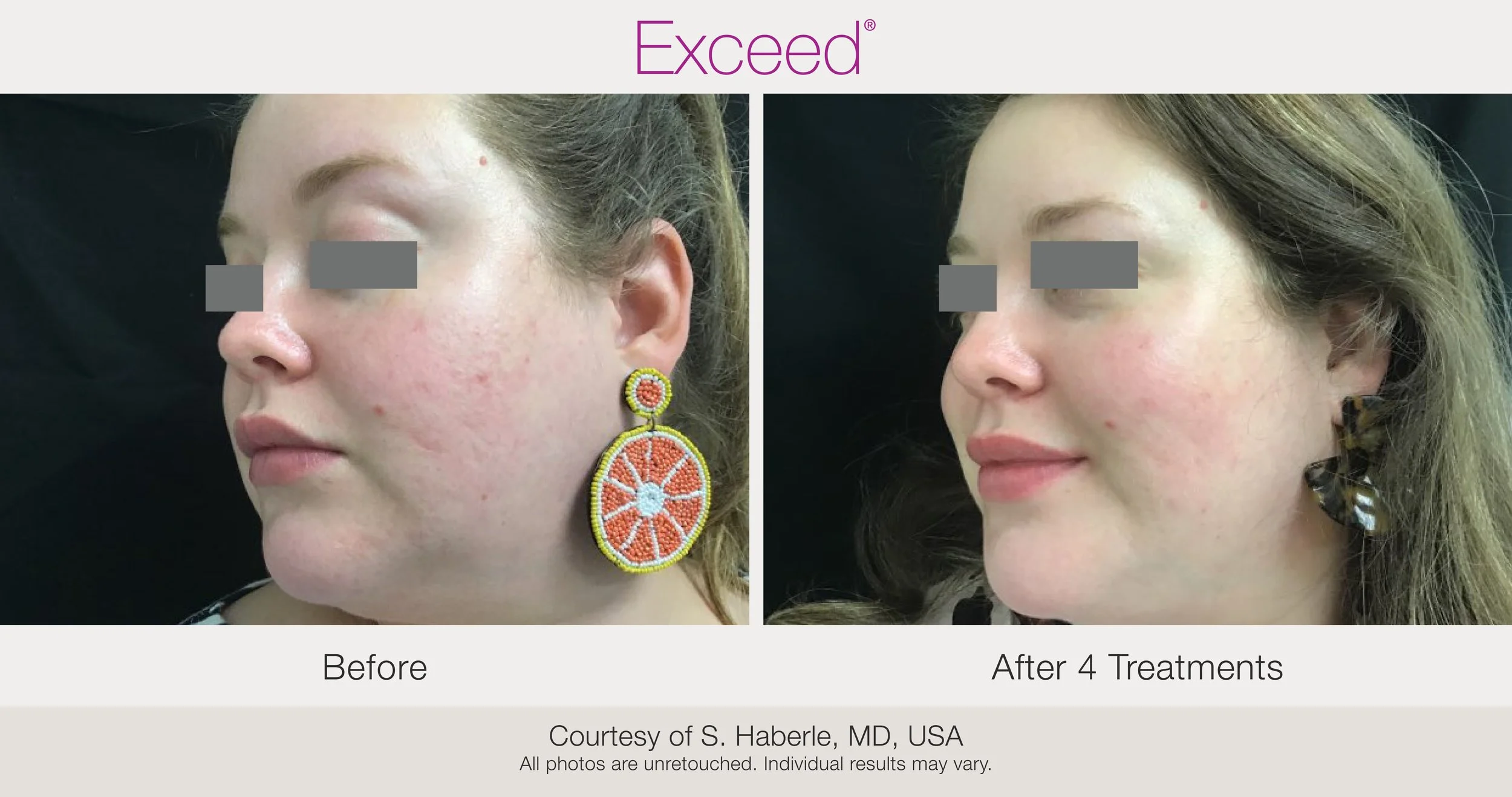
Exceed microneedling before and after picture
For acne scarring, microneedling wins over chemical peels in most cases, because it works at the depth where scar tissue actually lives instead of resurfacing the top layer. A peel can still do real work on tone and texture. Meg Bodi Skincare, based in Austin's Hancock neighborhood near Hyde Park, North Loop, and the North Campus / University area, offers both and will tell you honestly which one your skin needs before booking you for the more expensive option.
What's the actual difference between microneedling and chemical peels?
A chemical peel uses an acid solution to dissolve the top layers of skin so newer skin can surface underneath. It's a surface-level fix, which is exactly why it works so well for dullness, uneven tone, and fine lines that live in the epidermis.
Microneedling does something different. Fine needles create controlled micro-injuries deep in the dermis, which triggers your body's own wound-healing response and kicks collagen and elastin production into gear. Acne scars, especially the pitted or boxcar type, sit in that deeper layer. A peel can't reach them the way microneedling can.
Why does microneedling work better for acne scars specifically?
Scar tissue forms when the skin's healing process gets interrupted, usually by an inflamed breakout that damages the surrounding collagen structure. You can't smooth that out by removing dead skin cells on the surface. You have to rebuild collagen at the level where the damage happened.
At Meg Bodi Skincare, microneedling is performed using the Exceed® system by Candela Medical. According to the manufacturer's own clinical data, 86% of patients saw a reduction in acne scarring and 90% saw a reduction in facial wrinkles after four treatments. That's a strong number, and it's also worth knowing it comes from Candela, not an independent, peer-reviewed study. Ask before you book if you want to see the source data yourself.
Because this counts as a medical procedure in Texas, the service runs under the medical directorship of Dr. Jill Spital. That's not a formality. It's a legal requirement for any esthetician performing microneedling in this state, and it's worth asking any provider you're considering whether they actually have one.
When does a chemical peel make more sense than microneedling?
If your main concern is dullness, mild sun damage, or uneven pigmentation rather than pitted scarring, a peel is often the gentler, faster answer. Meg Bodi Skincare offers the Elaine Brennan Skin Renewal Peel, a cream-based peel done in a series of two, spaced eight to ten weeks apart, along with a lighter Micro-Peel version for people who want less downtime.
Peels also make sense if you're not ready for microneedling's cost or recovery window. There's no wrong answer here. It's a question of what your skin is actually dealing with.
What does microneedling cost at Meg Bodi Skincare, and is it worth it?
A single microneedling session runs $450, or $1,600 for a package of four, which is the number of treatments the clinical data is based on. Treatments are spaced four to six weeks apart. There's an optional $200 exosome upgrade per session for anyone who wants to push results further.
Every session includes medical-strength numbing, pre-treatment infrared LED, a growth-factor needling serum, post-treatment red light therapy, and a home care kit. Pricing and inclusions are current as of this writing but worth confirming directly with the studio, since service menus shift.
What should you expect during recovery for treatment?
Microneedling recovery looks like a moderate sunburn for one to three days: redness, tightness, maybe some pinpoint bleeding right after the treatment. Most people are comfortable back in public within a day or two, though makeup is typically off-limits for at least 24 hours.
Frequently Asked Questions
Does microneedling hurt more than a chemical peel?
Most people find microneedling more intense in the moment, which is why medical-strength numbing is standard at Meg Bodi Skincare rather than an optional add-on. A peel typically feels like warmth or light tingling rather than pain.
How many microneedling treatments will I need for acne scars?
The clinical benchmark is four sessions, spaced four to six weeks apart. Deeper or older scarring may need more; a consultation is the only way to know your specific timeline.
Is microneedling safe for darker skin tones?
Generally yes, since it doesn't rely on heat or light-based selectivity the way some laser treatments do, which lowers the risk of post-inflammatory hyperpigmentation. Any provider should still evaluate your specific skin during a consultation before treating you.
Can any esthetician perform microneedling in Texas, or does it require a doctor?
Texas classifies microneedling as a medical treatment, which means it must be performed under a medical director's delegation. Ask directly whether the person doing your treatment has that oversight in place.
Why Hard Wax Is the Best Choice for Sensitive Skin Body Waxing in Austin
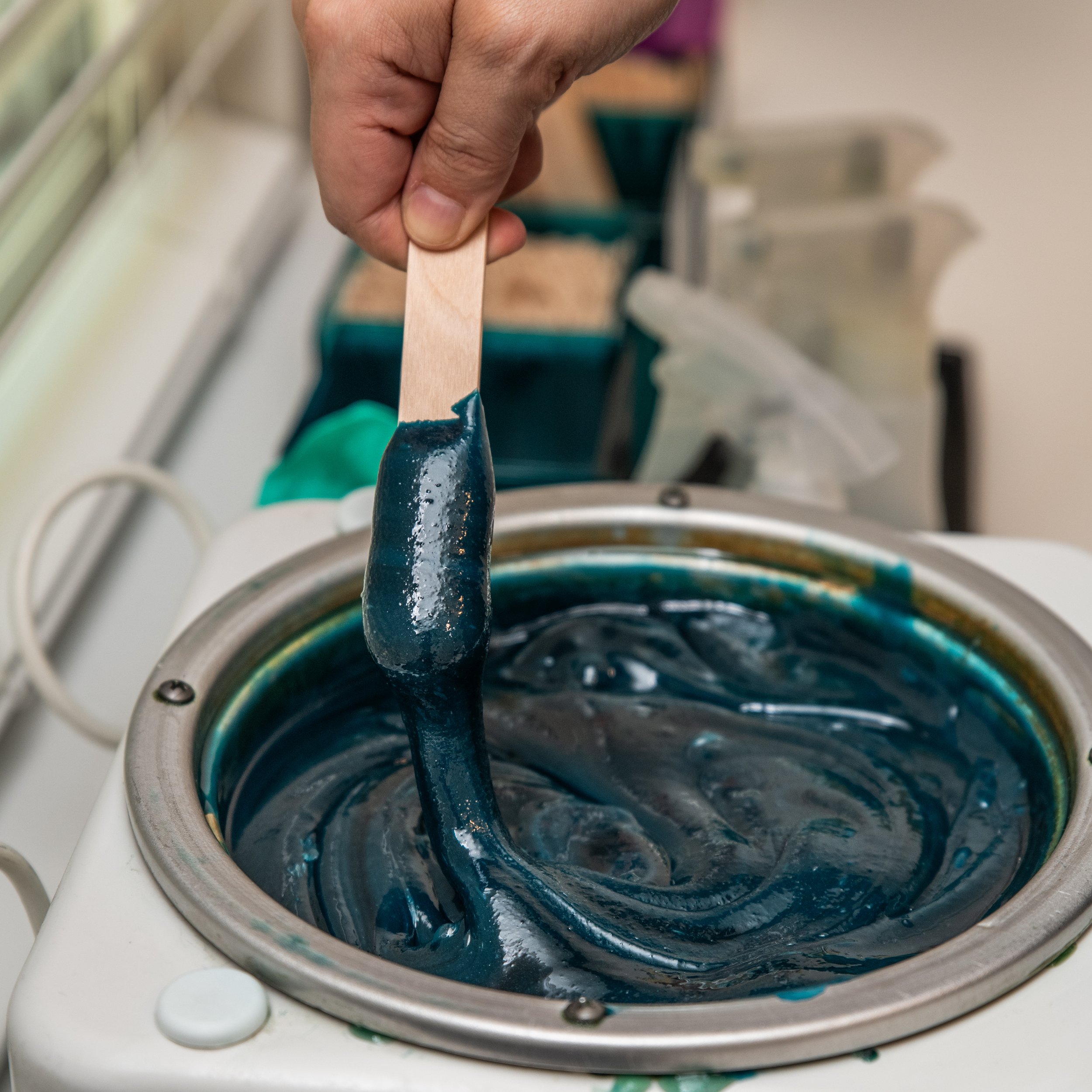
Melted waxing
Hard wax is the better choice for sensitive skin because it grips the hair, not the skin itself, so it lifts hair from the root without tearing at the surface the way strip wax can. Meg Bodi Skincare, based in the Hancock neighborhood of Austin near Hyde Park, North Loop, and the North Campus area, uses exclusively hard wax, built specifically for sensitive skin, across all body waxing services.
What's the Actual Difference Between Hard Wax and Strip Wax?
Strip wax is applied thin and pulled off with a cloth strip, which means it bonds to both hair and the top layer of skin. Hard wax goes on thicker, hardens on its own, and is removed by hand without a strip. Because it shrink-wraps around the hair shaft specifically, it releases from skin more cleanly, which means less redness, less irritation, and less risk of lifting live skin cells along with the hair.
For anyone who's had a bad reaction to strip waxing before, that difference isn't cosmetic. It's the reason hard wax has become the standard for sensitive areas across the industry.
Does Waxing Hurt Less With Hard Wax?
Comparing wax pain to a tattoo isn't far off. Everyone's threshold is different, and the people who claim it doesn't hurt at all are usually not being honest. What's true either way: you're pulling hair from the root, which means it grows back finer, the follicle weakens over time, and eventually some hairs stop coming back altogether. The sting lasts a second. For that trade, it's worth it.
Smaller, less sensitive areas hurt less, which is fairly intuitive once you think about it. Getting a good night's sleep and staying hydrated before your appointment also makes a real difference, since stress and dehydration both increase sensitivity.
How Should I Prepare for a Wax Appointment?
Arrive with clean skin, ideally freshly showered. Hair needs to be at least a quarter inch long, roughly the size of a grain of rice, since anything shorter won't lift with the wax and Meg can't trim it for you on arrival for sanitary reasons. Skip tanning beforehand. UV exposure inflames skin under the surface and makes waxing riskier, and spray tan will strip off with the wax anyway.
Exfoliate the area lightly the day before. Avoid shaving between appointments entirely, since it interferes with getting a clean, even result. If you're switching from shaving to waxing for the first time, expect to need two to three sessions spaced three to four weeks apart before every hair grows in on the same cycle.
What Should I Do After Waxing?
Meg applies a soothing serum immediately after your service. From there, leave the area alone for the rest of the day. No swimming, no gym, no repeatedly touching the skin to feel how smooth it is. If it's a hot Texas afternoon, which it usually is, rinse with a cool shower before bed rather than a hot one.
Avoid tanning for at least 48 hours. Freshly waxed skin has lost a layer of dead cells along with the hair, which leaves it more prone to burning, and a sunburned bikini line is not a good time for anyone involved.
Are There Reasons Someone Shouldn't Get Waxed?
Yes, and this list matters more than most people expect. Anyone currently on Accutane needs to be off the medication for a full year before waxing. Retin-A, Renova, Differin, and other skin-thinning acne medications also carry restrictions, and waxing on thin, compromised skin risks lifting or tearing.
Other conditions that call for caution rather than an outright stop include recent chemical peels or microdermabrasion (a mandatory seven-day wait), sunburned or irritated skin, moles in the treatment area, and recent laser resurfacing. Diabetic clients should check with their doctor first, given how the condition can affect healing and sensation.
Frequently Asked Questions
Can I get waxed while on my period?
Yes. For bikini or Brazilian waxing during your cycle, come in with a menstrual cup or fresh tampon, or use the supplies provided in the studio restroom. This can also be a more sensitive time to wax, so an over-the-counter pain reliever beforehand can help.
How often should I schedule waxing appointments?
Every four to six weeks is the standard recommendation for maintaining smooth results and encouraging hair to grow back finer over time.
What if I get ingrown hairs after waxing?
Don't pick at them. Gentle exfoliation with an antimicrobial scrub mitt, applied in circular motions, is the more effective approach, followed by a calming serum on the area.
Exceed Microneedling in Austin, TX: The Ultimate Solution for Acne Scars
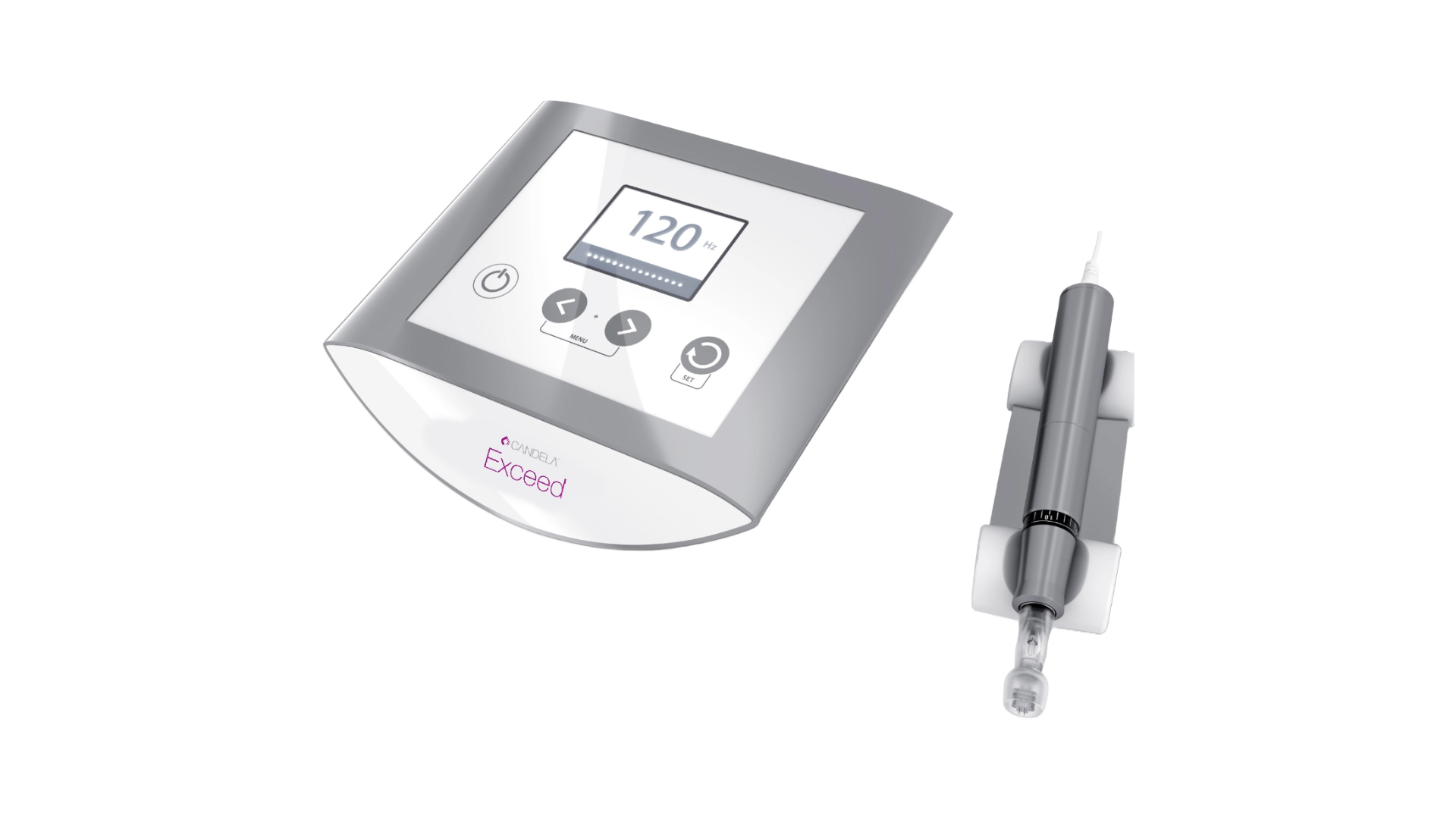
Exceed microneedling device
Exceed microneedling is a collagen induction treatment shown, in Candela Medical's own clinical data, to reduce acne scarring in 86% of patients within four sessions. Meg Bodi Skincare performs it in the Hancock neighborhood of Austin, close to Hyde Park, North Loop, and the North Campus area, under the medical directorship of Dr. Jill Spital.
That statistic comes from the device manufacturer, not an independent third-party study, so treat it as a strong signal rather than a guarantee. Individual results vary by scar type, skin, and how consistently you keep to the treatment schedule.
What Actually Happens During Microneedling?
A device covered in fine needles creates controlled micro-injuries across the treatment area. Your body reads that as damage and responds by producing more collagen and elastin, the two proteins responsible for firm, even, resilient skin. Over several weeks, that response starts filling in acne scarring, softening fine lines, and tightening enlarged pores.
It's sometimes called microchanneling or Collagen Induction Therapy, CIT for short, in clinical literature. Same treatment, different name depending on who's talking about it.
Why Exceed Specifically, and Not a Cheaper Device?
Not all microneedling is built the same. Meg uses the Exceed system from Candela Medical, and every session includes medical-strength numbing rather than an over-the-counter cream, pre-treatment infrared LED to prep the skin, an Ante-Age growth factor serum during needling instead of plain hyaluronic acid for slip, and post-treatment red light LED to calm inflammation. A home care kit comes included, not sold as an upsell afterward.
Cheaper setups skip most of that. Lower-grade tips or stamper-style rollers instead of a real medical device, no growth factor serum, no light therapy on either end, and a home care kit you're expected to buy separately. The medical-grade numbing alone means longer application time before your session even starts, which is part of why appointments here run longer than a quick in-and-out treatment elsewhere.
Is Microneedling Considered a Medical Treatment in Texas?
Yes. Texas classifies microneedling as a medical procedure, which means it legally requires performance under a medical director's delegation. Meg Bodi Skincare operates under Dr. Jill Spital in that capacity. If you're comparing providers anywhere in Austin, ask directly who their medical director is. If a studio can't answer that question clearly, that's worth taking seriously before you book.
How Many Treatments Will I Need for Acne Scarring?
Most improvement shows up across a series of four treatments, spaced four to six weeks apart to give your skin time to rebuild collagen between sessions. Rushing the schedule closer together doesn't speed up results, since the actual repair work happens between appointments, not during them.
What Does Microneedling for Acne Scars Cost at Meg Bodi Skincare?
A single session runs $450. A package of four, the number tied to that 86% figure, is $1,600. An Ante-Age Exosome upgrade is available for an additional $200 per session if you want to push results further. These figures reflect current published pricing and should be confirmed before booking, since service pricing shifts over time.
What Should I Expect for Downtime?
Redness and mild sensitivity are normal for a day or two after treatment, similar to a moderate sunburn. Because the numbing used here is medical-grade rather than topical over-the-counter cream, sessions run longer than what you'd get at a spa using a cheaper protocol. Most people are comfortable returning to normal activity within a day, though direct sun exposure should be avoided while skin is healing.
Frequently Asked Questions
Does microneedling hurt more than a regular facial?
It's more involved than a standard facial, but medical-strength numbing before needling keeps most of the sensation manageable. Expect some tenderness in the days after, not sharp pain during the appointment itself.
Can microneedling treat wrinkles as well as acne scars?
Yes. Candela's data shows 90% of patients saw a reduction in facial wrinkles after four Exceed treatments, alongside the acne scarring improvement. Same device, same collagen-building mechanism, applied to two different concerns.
How soon will I see results?
Collagen remodeling takes time. Most visible improvement builds gradually across the full four-treatment series rather than appearing after a single session.
Can I combine microneedling with a facial or other skin technology treatment?
Yes, though timing matters. Elaine Brennan peels, for example, pair well alternated with microneedling, but the two shouldn't be stacked in the same week. A Skin Consultation is the best way to sequence multiple treatments correctly.

Best Customized Facials in Austin, TX: What to Expect at Meg Bodi Skincare
The best customized facial in Austin, TX is one built around your skin as it looks that day, not a fixed script of steps. At Meg Bodi Skincare in the Hancock neighborhood, a short drive from Hyde Park, North Loop, and the North Campus / University area, esthetician Meg Bodi designs each facial from a real look at your skin rather than a set menu of add-ons.
What Makes a Facial "Customized" Instead of Standard?
A standard basic facial at most spas follows a script: double-cleanse, exfoliation, massage, mask, finishing products. Meg's Custom Facial skips the script entirely. It's never cookie-cutter and rarely the same twice, because the point isn't to check boxes. It's to clear your pores, calm what's flaring, and actually improve your skin's condition long term.
Part of that comes from client education. Meg talks through what she's doing and why while you're on the table, and she'll use the time to dig into what's actually causing the issue you came in for, not just treat the symptom sitting on the surface.
What Happens During a Customized Facial Appointment?
You'll check in through the Vagaro app or the electronic doorbell when you arrive, and Meg comes to let you into the studio. From there, she walks you back to the treatment room, explains what level of undress the service calls for, and shows you how to get positioned on the table. While you settle in, she preps her supplies and answers any last questions.
If you're coming in for a Skin Consultation, Advanced Skin Analysis, or Acne Intake Session specifically, fill out your intake form with real detail beforehand. List every product you use, morning and night, by brand name. Bring the bottles if you can. Ingredient formulas change often enough that the label in your bathroom is more reliable than a Google search.
Do I Need to Prepare My Skin Before a Facial?
Come in with clean skin. Do your usual PM routine the night before, then rinse with cool water the next morning and skip everything else. No moisturizer, no serum, nothing.
This matters because Meg photographs your skin with the Observ520x skin analysis system before treating it, and product residue distorts what the camera actually sees underneath.
Will the Facial Hurt?
Mostly, no. Most of what happens during a facial doesn't hurt at all. The exception is extractions. If you're coming in specifically for an acne treatment with significant extractions, expect some discomfort during that part. Everything else on the table should feel closer to relaxing than clinical.
What Do I Do After a Facial?
Nothing dramatic, most of the time. Skip active ingredients like retinol or acids the night of your appointment and go back to your normal routine the following day. Facials involving heavier extraction work, usually acne treatments, benefit from icing the skin afterward to bring down any inflammation.
Some treatments run on a different timeline. Microneedling and chemical peels both require more downtime than a standard facial, so don't assume the same one-day rule applies across every service on the menu.
What If I'm Not Sure Which Skin Service to Book?
Book a Skin Consultation first. Meg looks at your skin, listens to what you're trying to change, and recommends the actual treatment path, whether that's a Custom Facial, microneedling, a peel, or some combination across a few visits. Guessing from a service list rarely gets you to the right answer faster than just asking.
Why Does Meg's Background Matter for a Facial?
Fifteen years in, thirteen of them running her own studio since June 2013, Meg has built a credential list that goes past basic esthetics. She's a member of the International Association of Applied Corneotherapy, an approach focused on repairing the skin barrier instead of attacking it aggressively. She's also a member of Oncology Esthetics International, which reflects specialized training for clients recovering from cancer treatment.
Add her certification in the Pastiche Method of advanced skin analysis, which is built around finding root causes rather than surface symptoms, and a facial here starts to look less like a spa amenity and more like a working diagnostic session.
Frequently Asked Questions
How much does a customized facial cost at Meg Bodi Skincare?
Pricing isn't listed publicly for Custom Facials, since the treatment plan and add-ons vary by client. Current rates are confirmed at booking or by contacting the studio directly.
How often should I get a facial?
This depends on your skin goals and what came up in your consultation. Some clients come monthly for maintenance, others space visits further apart around a specific concern like acne or barrier repair. A Skin Consultation is the fastest way to get a real answer instead of a generic recommendation.
Can I combine a facial with microneedling or another skin technology treatment?
Yes. Meg's skin technology offerings, including LED light therapy, Jet Clear hydrodermabrasion, and Elaine Brennan peels, are often used alongside or between facials as part of a longer-term plan.
Does Meg Bodi Skincare work with clients recovering from cancer treatment?
Yes. Meg's membership in Oncology Esthetics International reflects specific training in adapting skincare for post-treatment sensitivity and skin changes. Services begin once active cancer treatment is complete.

Best Facial in Austin for Cancer Survivors
Meg Bodi Skincare’s hydration facial that is for immunocompromised people, prior oncology patients, and people who have had cancer.
If you're searching for the best facial in Austin for someone who's had cancer, the credential to look for is Oncology Esthetics International certification, not just a spa that advertises "gentle" treatments. Meg Bodi Skincare, based in the Hancock neighborhood near Hyde Park, North Campus, and North Loop in austin texas, is a certified member of Oncology Esthetics International and only begins skincare services once active treatment is fully complete.
Here's what actually matters if you're the one making this decision for yourself or for someone you love.
What Should You Look for in a Post-Cancer Facial Provider?
Not certification in general. Oncology-specific certification. A lot of estheticians can talk convincingly about "sensitive skin" without ever having trained on what chemotherapy, radiation, or hormone therapy actually does to a skin barrier.
Ask directly: does this person hold a real oncology esthetics credential, or are they just being cautious because it seems like the responsible thing to say? The two look identical in a sales conversation and very different in the treatment room.
Why Meg Bodi Skincare Comes Up for This Search
Meg is a member of Oncology Esthetics International, which reflects specific training in adapting skincare for clients recovering from cancer treatment — treatment-related skin sensitivity, barrier changes, the works. She's also built her whole practice around corneotherapy, a skin-science approach focused on repairing and protecting the skin barrier rather than pushing aggressive or invasive treatments. For skin that's already been through chemotherapy or radiation, that's the right instinct before it's even a specialty.
Meg Bodi Skincare has been open since June 2013, and Meg has practiced esthetics for 15 years. The studio sits at 927 East 41st Street, right in the Hancock neighborhood, an easy trip from Hyde Park, the North Campus and University area, and North Loop.
One thing stated plainly on the site: skincare services begin once treatment is complete. Not during. If you're currently mid-treatment, this isn't the right search yet — bookmark it for later.
What Happens During a Facial If You've Had Cancer Treatment?
Facials at Meg Bodi Skincare are customized to each client's skin, and for someone recovering from cancer treatment, that customization matters more than usual. Skin post-chemo or post-radiation isn't just "sensitive" in the generic sense — barrier function is often compromised, and standard exfoliation or actives that would be fine on typical skin can cause real irritation.
The exact protocol Meg uses for post-cancer clients specifically (which products, which techniques she avoids, how she adjusts pressure or timing) isn't detailed publicly on the site beyond the general oncology esthetics credential. This is a section Meg should review and add specifics to before publishing — client trust on a topic this personal depends on precision, not general reassurance.
When Can You Book a Facial After Finishing Treatment?
The site states services begin once active treatment is complete, but doesn't publish a specific waiting period — no "wait six weeks" or "wait until your oncologist clears you for X." That's a real gap, and I'm not going to invent a number to fill it.
If you're in this situation, the honest answer is: ask during a consultation, and loop in your oncology team if there's any doubt. Meg should confirm here whether she has a standard timing guideline she gives clients, even an informal one, so this section can say something concrete instead of gesturing at "it depends."
Why There's No Ranked List Here
Plenty of pages answering "best places for a facial after cancer in Austin" will hand you five names pulled from a directory scrape, most of which have never verified whether those studios have any oncology-specific training at all. That's not more helpful. It's just faster to publish.
The more useful move: call around. Ask the specific question — "are you certified in oncology esthetics, and what does that training actually cover?" Providers who can answer immediately are the ones worth trusting. Providers who default to "we're always very gentle" usually mean well and know less than they think.
Frequently Asked Questions
Does having had cancer disqualify me from getting a facial?
No. Meg Bodi Skincare's site is explicit that skincare services begin once active treatment is complete — having had cancer isn't a disqualifier, timing is the operative issue.
Is microneedling safe after cancer treatment?
Not something to answer with a blanket yes. Microneedling is classified as a medical treatment in Texas and is performed at Meg Bodi Skincare under the medical directorship of Dr. Jill Spital. Whether it's appropriate for a specific person post-cancer depends on individual factors an esthetician and, ideally, an oncology team should weigh in on together. This is a conversation to have directly, not a decision to make from a blog post.
Do I need a note from my oncologist before booking?
The site doesn't state this as a requirement. As general best practice, checking with your oncology team before any new skin treatment post-cancer is reasonable, especially early in recovery. Meg should confirm whether she requires or requests this.
What if I'm still on maintenance hormone therapy, like tamoxifen?
This sits in a gray area between "active treatment" and "fully done," and the site's current language doesn't address it directly. Flagging this for Meg to clarify — it's a common enough situation that clients will ask.

Best Facials for Cancer Patients in Austin, TX: What to Look For
Hydration Facial by Meg Bodi Skincare that is for immunocompromised, oncology patients, or people who have had cancer.
If you're searching for the top places to get a facial after cancer treatment in Austin, the honest answer is that the list is short, because oncology esthetics training is rare, not because facials themselves are risky. Meg Bodi Skincare, located in the Hancock neighborhood near Hyde Park, North Campus and the University area, and North Loop in austin texas, is a member of Oncology Esthetics International, which is the specific credential to check for before booking anywhere in the city. That membership, not a spa's size or star rating, is what actually tells you whether an esthetician knows how chemo and radiation change skin.
What actually qualifies a facial studio to work with cancer patients?
Not a wellness certificate. Not "sensitive skin" language on a website. The credential that matters is a real oncology esthetics education, the kind offered through organizations like Oncology Esthetics International, which trains estheticians in how specific treatments affect skin, nails, and lymphatic function long after chemo or radiation ends.
Meg holds this membership. It shows up on her site's About page alongside her other training, and it's the reason she can speak specifically to treatment-related sensitivity instead of guessing at general "gentle" protocols. If a studio can't point to comparable training, ask directly what their oncology-specific education actually covered.
Are there other oncology-trained estheticians in Austin?
Probably, somewhere. I don't have a verified, current list of every Austin esthetician holding an oncology esthetics credential, and I'm not going to pretend I do. If you want to check for yourself, Oncology Esthetics International maintains a practitioner directory, and that's a better source than any local "best of" roundup, including this one.
What I can tell you with confidence: Meg Bodi Skincare has held this membership for years, operates out of a studio in the Hancock neighborhood a few minutes from Hyde Park and North Loop, and treats it as a defining part of her practice rather than a marketing line.
Why does the neighborhood matter for this kind of appointment?
It probably matters less than the credential, but if you're coming from Hyde Park, North Campus, or North Loop, Meg Bodi Skincare sits right in the middle of that stretch of Austin, on East 41st Street. For someone managing fatigue or limited stamina post-treatment, a short drive is not nothing.
What makes a facial different for someone who's finished cancer treatment?
Chemotherapy and radiation change the skin's barrier function, hydration, and sensitivity, sometimes for months after the last session ends. A facial built for that reality adjusts pressure, product strength, and treatment selection around what your skin can currently handle, not a standard menu built for unaffected skin.
Meg's approach already leans this direction for every client. She's also a member of the International Association of Applied Corneotherapy, an approach focused on protecting the skin barrier rather than pushing aggressive treatment, which lines up well with what post-treatment skin usually needs.
Does Meg Bodi Skincare treat clients during active cancer treatment?
No. Skincare services begin once active treatment is complete. This isn't a soft preference, it's how oncology esthetics training is structured, since skin behaves very differently during treatment than it does in the months after.
If you're currently in treatment and looking ahead, that's still worth knowing now. Book the consultation for later, and use the time to ask what your oncology team thinks about elective skin treatments once you're cleared.
What should you ask before booking anywhere in Austin?
Ask what oncology-specific training the esthetician actually completed, not just whether they'll be "gentle." Ask how far out from your last treatment they typically start seeing clients. Ask whether they'll adjust the plan if a spot on your skin still hasn't fully recovered, rather than running a fixed protocol regardless of how you present that day.
A studio that answers these clearly, with actual training behind the answer, is doing the job right. One that gets vague or defensive is telling you something too.
Frequently Asked Questions
Is it safe to get a facial after finishing chemo or radiation?
Generally yes, once your oncologist has cleared you for elective treatments and active treatment has ended. Timing depends on your specific treatment and how your skin responded, which is why a general "when can I get a facial" timeline doesn't apply evenly to everyone.
Does insurance cover facials for cancer survivors?
No. Facials, including oncology-adapted ones, are considered elective cosmetic services and aren't covered by insurance, regardless of medical history.
Can Meg Bodi Skincare treat lymphedema-related concerns during a facial?
Meg holds certification in Facial Manual Lymphatic Drainage. If lymphedema is a concern for you, mention it directly when booking so the appointment can be planned around it rather than discovered mid-treatment.
What if I had radiation to my face or neck specifically?
Say so when you book. Radiation to the face or neck carries different, often longer-lasting skin considerations than treatment elsewhere on the body, and an esthetician with oncology training will ask about this before planning your facial.

How Long Is Microneedling Downtime, Really?
Most people are red and a little tight-feeling for 24 to 72 hours after microneedling, similar to a mild sunburn, and back to normal-looking skin within about a week. There's no peeling off in sheets and no reason to cancel your week. At Meg Bodi Skincare, based in the Hancock neighborhood near Hyde Park, North Campus, and North Loop in Austin texas, clients hear the same thing during their consult: the redness fades fastest on the face, while the neck and chest, if treated, tend to hang onto color a day or two longer.
What Does Microneedling Downtime Look Like, Day by Day?
Day 0 (treatment day): Skin is flushed, warm, and slightly swollen, especially around the cheeks and forehead. You might see pinpoint spots where the needles broke the surface. This calms within a few hours for most people.
Days 1–2: This is peak redness. Skin can feel tight, a little sandpapery, and warm to the touch. Makeup is generally fine once any pinpoint bleeding has fully closed, though going bare for the first 24 hours gives your skin one less thing to deal with.
Days 3–5: Redness fades to a light pink or disappears entirely. Some people get faint, dry flaking as the outer layer turns over. Don't pick at it.
Day 6–7 and beyond: Skin looks normal. This is also when the real work is happening underneath, since collagen remodeling continues for weeks after the surface has settled.
Individual healing speed varies with skin type, hydration, and how deep the treatment went, so treat this as a typical range rather than a guarantee.
How Soon Can I Wear Makeup or Go Back to Work After Microneedling?
Most clients return to work the same day or the next morning without anyone noticing anything beyond "you look like you got some sun." If your job is client-facing and you want zero visible redness, book on a Thursday or Friday and let the weekend absorb the worst of it.
Meg gives specific post-treatment instructions and a home care kit with every microneedling appointment at Meg Bodi Skincare, and those instructions should take priority over anything general you read here. If you have a specific event or work situation you're timing around, ask before you book.
Does the Exceed® Device Change the Downtime Experience?
Meg Bodi Skincare uses the Exceed® device from Candela Medical, and the protocol built around it is different from a bargain microneedling appointment. Every session includes medical-strength numbing (not an over-the-counter cream), pre-treatment infrared LED light, an Ante-Age growth factor needling serum instead of plain hyaluronic acid for slip, and post-treatment red light LED therapy. Red light is commonly used post-procedure to help calm inflamed skin, though the exact effect on any one person's downtime isn't something that's been separately measured for this specific protocol.
None of that shortens the biological healing timeline in a dramatic way. What it changes is comfort during the appointment and, for many clients, how settled the skin feels walking out the door.
How Many Microneedling Treatments Will I Need?
In the clinical studies behind the Exceed® device, 86% of patients saw improvement in acne scarring and 90% saw improvement in facial wrinkles after four treatments, spaced four to six weeks apart. A single session runs $450, or $1,600 for a package of four. An Ante-Age exosome upgrade is available for $200 per session if you want to add it.
Four to six weeks between treatments isn't arbitrary. It's roughly how long the collagen remodeling process from one session needs before another round of micro-injury is useful rather than just repetitive.
How Can You Shorten Microneedling Recovery Time?
Skip retinoids, exfoliating acids, and other active ingredients for a few days before your appointment; irritated skin heals slower and reacts more to the needling itself. Come in hydrated. After treatment, stick to the home care kit, avoid the gym and direct sun for the first day or two, and wear a real SPF once you're back outside. Sweat and unprotected sun are the two things most likely to turn a two-day recovery into a five-day one.
Who Should Time Microneedling Carefully, or Skip It?
Microneedling is classified as a medical treatment in Texas, and at Meg Bodi Skincare it's performed under the medical directorship of Dr. Jill Spital. That matters for downtime too: active acne breakouts, cold sores, recent sunburn, and certain skin-thinning medications like Accutane or Retin-A can all extend recovery or make treatment inadvisable that week. If you're pregnant, on blood thinners, or unsure whether a medication you're taking is a problem, say so before you book rather than after.
FAQ
Is microneedling downtime worse than a chemical peel? Generally, no. A medium-depth chemical peel often means visible peeling for 5–7 days. Microneedling downtime is shorter and less dramatic to look at, though it can feel more tender to the touch on day one or two.
Can I get microneedling before a wedding or big event? Yes, with a buffer. A good rule of thumb is your last microneedling session at least three to four weeks before the event, both to clear visible downtime and to let the skin benefits actually show up. Don't schedule your first-ever session for the week of.
Does adding the exosome upgrade change downtime? it depends on the individual and the specific formulation used that session. Ask at booking if this is a deciding factor for you.
Does downtime get shorter after multiple treatments? Many clients report their skin "knows what to do" by the third or fourth session and calms faster, but this is anecdotal rather than something the clinical data specifically tracked.
When should I actually be concerned about how my skin looks after microneedling? Redness past day 4 or 5, increasing pain instead of decreasing, pus, or fever are reasons to call the studio, not wait it out. Two days of redness is normal. That kind of pattern is not.
If you're weighing microneedling downtime against your calendar, book a consultation with Meg and get a timeline specific to your skin instead of a general one.
What to Expect the Day After Microneedling
The day after microneedling, the way your skin looks depends a lot on the quality of the microneedling device the esthetician uses. At Meg Bodi Skincare, based in the Hancock neighborhood near Hyde Park, North Campus, and North Loop in austin texas meg uses the exceed device by industry standard-bearer Candela Medical. With this device your face presents with a uniform, light pink or mild red flush similar to a subtle sunburn. Because vertical 90 degree punctures create isolated micro-channels that close rapidly, there are no visible scratches, track marks, or surface bleeding patches. With cheap rollers and stampers, the skin often looks blotchy, prematurely scabbed, or cross-hatched with faint red lines. Derma rollers carve arching micro-tears as they rotate out of tissue, resulting in visible scratch-like striations and localized pinpoint bruising. Low-tier stampers cause uneven pressure spots, leaving patchy, inflamed marks. Most of megs clients are surprised by how normal they feel the next morning. The redness looks more dramatic than it feels.
How red will my skin be the day after microneedling?
Redness typically peaks in the first 24 hours and starts fading by day two or three. Some clients look like they spent an afternoon at Barton Springs without sunscreen. Others barely pink up at all.
Depth of the treatment, your skin type, and how your body handles inflammation all play a role. If you're on the sensitive side, or if you've had rosacea flare in the past, tell your esthetician before treatment so the settings can be adjusted.
Can I wear makeup the day after treatment?
Skip it for at least 24 hours, and ideally longer if you can swing it. Your skin has thousands of microscopic channels open from the treatment, and makeup, brushes, and sponges introduce bacteria right into them. That's how breakouts and irritation happen after an otherwise clean treatment.
If you have to be presentable the next day, plan around it. Book microneedling for a Friday, not the morning of a wedding.
What should I put on my skin the next day?
Gentle and minimal. A fragrance-free cleanser, a plain moisturizer, and mineral sunscreen if you're heading outside. No retinol, no exfoliating acids, no vitamin C serums, nothing "active" until your skin gives you the green light, which is usually 5 to 7 days depending on how your provider set up your home care kit.
This is one area where I'd rather you follow the exact instructions handed to you at checkout than a generic list off the internet. Skin heals on its own timeline, and your provider adjusted your protocol to your face specifically.
Is it normal for my skin to feel tight or itchy?
Yes. Tightness is dehydration and healing doing their thing. Itchiness usually means the skin is repairing itself and new tissue is forming underneath. Neither is a sign something went wrong.
What's not normal: itching so intense you're tempted to scratch, spreading redness that gets worse instead of better after day two, or any pus-like discharge. That combination points to irritation or infection, not normal healing, and it's worth a call to whoever performed your treatment.
When can I go back to my normal skincare routine?
For most people, five to seven days. Sweat, heat, and friction are the real enemies right after treatment, so hold off on the gym, hot yoga, and saunas for at least 24 to 48 hours. Austin in July makes this rule painfully easy to break and painfully important to follow.
Sun exposure is the other big one. Freshly microneedled skin sunburns faster and can hyperpigment if you're not diligent about SPF, so that mineral sunscreen isn't optional for the two weeks after treatment.
What if my skin looks worse on day two or three than day one?
This happens more than people expect, and it doesn't mean anything's wrong. Peak inflammation for some skin types actually lands 48 to 72 hours out, not immediately post-treatment. You might see more flaking or a rougher texture right as you were expecting things to calm down.
Give it until day four or five before you worry. If it's still escalating past that point, that's when to reach out to your provider rather than wait it out.
Frequently Asked Questions
Can I shower the day after microneedling?
Yes, lukewarm water only. Skip hot showers and steam for the first day or two since heat increases inflammation and can worsen redness.
Will I see results the day after?
No, and that's expected. Microneedling triggers collagen production that unfolds over weeks. The Exceed device we use at the studio is clinically shown to reduce acne scarring in 86% of patients and facial wrinkles in 90% of patients, but that's measured after four treatments, not one.
How long until I can wax or get a facial after microneedling?
Give it at least two weeks for anything with exfoliation or extraction involved. Your skin barrier needs time to fully close back up first.
Can I take ibuprofen for the discomfort?
I'm not able to give medical advice on medication, so check with your doctor. Most people find the day-after sensation more like sunburn tightness than pain requiring anything beyond what they'd normally take for a headache.
Does everyone get the same level of redness?
No. I've had clients walk out looking barely touched and others who needed a full day before they felt comfortable running errands. Skin type, treatment depth, and how hydrated you were going in all factor into it.
A note on the numbers: pricing and package details for microneedling are current as of this posting but worth double-checking on the microneedling service page before booking, since studio pricing gets reviewed periodically.
If your skin is doing something on this list that doesn't match "normal," don't guess. Reach out through the studio FAQs or text the number on the microneedling page directly. And if you're microneedling-curious but haven't booked your first session yet, that's exactly what a skin consultation is for.
Does Microneedling Hurt?
Whether microneedling hurts depends entirely on the quality of the numbing cream and how long it sits on your skin—quick over-the-counter creams only deaden the surface, leaving deeper nerves active to feel sharp pinpricks, whereas medical-grade numbing applied for an extended period completely blocks pain deep in the dermis. At Meg Bodi Skincare, located in Hancock neighborhood, convenient to Hyde Park, North Campus, and North Loop in austin texas, she uses prescription-strength numbing and gives it generous absorption time, which is why her treatments are booked for 90 minutes instead of the standard 60 minutes. That extra time guarantees your skin is thoroughly numb so you feel only light pressure, allowing her to comfortably reach the deeper therapeutic needle depths needed for real skin results.
What Does Microneedling Actually Feel Like?
Picture a very fast, very small electric toothbrush pressed against your skin. That's closer to reality than "needles," even though needles are exactly what's happening at a microscopic level.
The device creates tiny channels in the skin to trigger collagen production, and those channels are so fine that what you feel is more sensation than injury. Thin-skinned spots like the forehead, temples, and around the mouth tend to register more. Cheeks and jawline usually feel like almost nothing. Nobody's face reacts identically, so your particular map of sensitive spots might look different from your friend's.
Does Meg Bodi Skincare Numb You Before Microneedling?
Yes, and it's medical-strength numbing, not the over-the-counter cream some studios rely on. Every microneedling appointment here includes it as a baseline part of the treatment, along with pre-treatment infrared light therapy to prep the skin and red light therapy afterward to help it settle.
That's a different standard than a lot of med spas operate under. Some places charge extra for numbing, or skip the growth-factor serum and use plain hyaluronic acid for slip instead. The number of tools stacked before and after the actual needling changes what the forty-five minutes on the table feels like, not just the results four weeks later.
Which Parts of the Face Hurt More During Microneedling?
Bone-close areas. Forehead, hairline, jawline, and the thin skin around the lips and nose carry less cushion, so the needling registers more sharply there. The cheeks, being fleshier, tend to feel duller, more like pressure than pinch.
If you've had a tattoo or a piercing before, you already have a rough sense of your own pain map. People who found ribs or ankle bones brutal for ink tend to feel microneedling more over their own forehead and jaw. It's not a perfect correlation, but it's a decent predictor.
What Happens After the Numbing Wears Off?
Expect warmth and tightness that reads a lot like a mild sunburn, generally settling within 24 to 48 hours. Some people are pink and glowy by the next morning. Others carry more visible redness for a full two days, especially if it's their first treatment or they run a stack of active ingredients at home already.
This part varies more by individual than the actual treatment does. Skin type, hydration, sleep, and how aggressive your regular skincare routine already is all play into how loud your skin is afterward. If you're nervous about downtime bumping into a big event, plan the appointment with a few extra days of buffer rather than cutting it close.
How Many Sessions Does It Take to See Results?
Meg Bodi Skincare uses the Exceed® device, which has been clinically shown to reduce acne scarring in 86% of patients and facial wrinkles in 90% of patients after four treatments, spaced four to six weeks apart. That's not a one-and-done service. Collagen remodeling takes time, and the four-treatment arc is where the clinical data actually sits.
A single session runs $450. A package of four is $1,600, which works out to real savings if you're planning to do the full course anyway. An optional Ante-Age exosome upgrade adds $200 per session for anyone chasing faster or more dramatic results.
Because microneedling is classified as a medical treatment in Texas, it's performed here under the oversight of a medical director. That's worth asking about wherever you book, since not every studio operates under that structure.
Frequently Asked Questions
Does microneedling hurt more than a facial? More than a standard facial, yes, but less than most people brace for. A custom facial rarely causes discomfort outside of extractions. Microneedling involves actual needle penetration, even at a shallow depth, so there's more sensation involved, just blunted heavily by the numbing step beforehand.
Does microneedling hurt more than waxing? Different kind of sensation entirely. Waxing is a sharp, one-second rip. Microneedling is a longer, duller buzz spread across several minutes per area. Most people who tolerate waxing fine find microneedling milder, since there's no root being pulled.
Can I still get microneedling if I have a low pain tolerance? Yes. Numbing time can be adjusted, and the technician can work more slowly over your most sensitive zones. Mention your pain tolerance before the appointment starts so the pacing gets built around it rather than adjusted mid-treatment.
Will makeup or sunscreen sting afterward? Possibly, for the first several hours. Skin is more permeable right after microneedling, which is part of why the growth-factor serum absorbs so well during treatment. It's also why most product application, including makeup, gets held off until the next day.
How long before I can work out or go out in the sun after microneedling? Sweat and sun exposure are both discouraged for at least 24 hours. Freshly channeled skin is more reactive to both heat and UV, and pushing it too soon tends to extend the redness rather than shorten recovery.
Have more questions about what to expect? The full FAQ page covers prep, aftercare, and studio logistics in more detail.

Best Microneedling Near Austin, TX? What Actually Separates Good From Great
The best microneedling near Austin, TX comes down to three things: the device doing the needling, who's overseeing the treatment medically, and whether the numbing and aftercare are actually built into the price. Meg Bodi Skincare, located in the Hancock neighborhood near Hyde Park, North Campus, and North Loop in Austin texas, uses the Exceed device from Candela Medical under the medical directorship of Dr. Jill Spital, with clinical results showing acne scar reduction in 86% of patients and wrinkle reduction in 90% after four treatments. That combination, real device, real oversight, real numbers, is what "best" should mean when you're comparing options.
It's also the part most microneedling marketing skips.
What Makes One Microneedling Treatment Better Than Another?
Not all microneedling is the same procedure wearing different names. The needle depth, the device quality, and what happens before and after the needling all vary wildly between providers, and that variation is where most of the results (or lack of them) come from.
At Meg Bodi Skincare, every microneedling session includes infrared LED therapy before treatment, an Ante-Age growth factor serum during needling, red light LED therapy after, and a home care kit, with an optional exosome upgrade. Some studios substitute a cheaper stamper or dermaroller for a medical-grade device, skip growth factors in favor of plain hyaluronic acid for slip, and charge separately for the home care kit you need to heal properly. Same category of treatment. Different treatment entirely.
Microneedling is also classified as a medical procedure in Texas, which means the provider should be operating under a licensed medical director. Ask who that is before you book. If nobody has a clear answer, that's your answer.
How Much Does Microneedling Cost in Austin?
At Meg Bodi Skincare, a single microneedling treatment runs $450, or $1,600 for a package of four (roughly $400 per session). Treatments are spaced four to six weeks apart, and an Ante-Age exosome upgrade adds $200 per session.
Package pricing tends to be worth it if you're treating something structural, like acne scarring, since the clinical data behind Exceed is built around a four-treatment course. A single session can still improve texture, but it won't get you the 86% and 90% figures cited above. Those numbers are specifically tied to completing the full series.
What Results Can You Actually Expect From Microneedling?
Within the studied four-treatment course using the Exceed device, 86% of patients saw reduced acne scarring and 90% saw reduced facial wrinkles. Those are the manufacturer's clinical results for this specific device and protocol, not a universal guarantee across every microneedling machine on the market, which is exactly why the device matters as much as the technique.
Individual results still depend on skin type, scarring depth, and how your skin responds to collagen induction, so a consultation before your first session matters more than the marketing copy on any studio's website. Meg's approach leans on corneotherapy, prioritizing the skin's barrier function alongside the treatment itself, rather than pushing for aggressive results at the expense of how your skin holds up long-term.
Who Is Actually Doing the Needling at Meg Bodi Skincare?
Meg has been an esthetician for 15 years, running her own practice since June 2013. Her microneedling training specifically includes certification under Dr. Lance Setterfield, a physician and leading educator in collagen induction therapy, plus device-specific training through Texas Laser Institute and Candela.
That's a meaningfully different résumé than someone who took a weekend microneedling course and started booking clients the following Monday. Training under a physician educator, not just a device rep, tends to show up in how conservatively a practitioner needles sensitive areas and how they handle a face that isn't responding the way the textbook says it should.
Is Microneedling Safe for All Skin Tones?
Because microneedling works mechanically, creating controlled micro-injuries that trigger collagen production, rather than relying on heat or light targeting pigment, it's generally considered appropriate across a wider range of skin tones than treatments like certain lasers. That said, individual risk factors like active acne, keloid tendency, or certain skin conditions still need to be assessed one-on-one. A proper consultation, not a generic FAQ page, is where that gets sorted out.
Does Microneedling Hurt?
Discomfort varies by depth and pain tolerance, but medical-strength numbing (as opposed to an over-the-counter numbing cream) makes most sessions tolerable rather than something you white-knuckle through. If a studio is using OTC numbing only, expect more discomfort, particularly on denser needling passes.
How Soon Will I See Results?
Collagen remodeling takes time. Some texture improvement shows up within a couple of weeks as skin heals, but the meaningful changes in scarring and wrinkle depth build across the full treatment course, with most clinical improvement documented after four sessions spaced four to six weeks apart.
Can Microneedling Be Combined With Other Treatments?
Yes, though sequencing matters. Microneedling pairs well with a customized facial protocol on a separate visit rather than stacking heavy actives into the same session as needling, since your skin barrier is temporarily more permeable right after treatment. If you're already getting customized facials at a studio, ask how they sequence the two rather than assuming more is always better.
If you're weighing microneedling against other in-studio options, the skin technology page breaks down what else is available, and the studio FAQs cover booking, cancellation, and prep questions that don't fit neatly into a treatment comparison.

Skincare After Cancer Treatment: What Corneotherapy Can Do for Your Skin
If you've been through chemotherapy, radiation, or hormone therapy, your skin didn't come out the other side the same. It's thinner in places, more reactive, sometimes drier than it's ever been, sometimes breaking out for the first time in your life. Corneotherapy is the branch of skincare science built for exactly this: rebuilding the skin barrier instead of stripping or stimulating it further. It's the approach behind oncology esthetics, and it's why a lot of standard spa facials aren't a good fit for post-treatment skin. meg bodi skincare in in the Hancock neighborhood near Hyde Park, North Campus, and North Loop in austin texas is a Member of the International Association of Applied Corneotherapy (a professional association for corneotherapy, a skin-science approach centered on repairing and maintaining the skin's barrier rather than aggressive treatment), and a Member of Oncology Esthetics International which reflects specialized training in adapting skincare for clients who have completed cancer treatment, including treatment-related skin sensitivity and changes.
What Is Corneotherapy?
Corneotherapy treats the outermost layer of skin, the stratum corneum, as a living structure that needs to be protected and repaired rather than exfoliated into submission. The framework comes out of the work of Dr. Alfred Hofer and Dr. Anton de Villiers, and it's formalized today through the International Association for Applied Corneotherapy (IAC). An esthetician trained in corneotherapy is looking at barrier function first: ceramide levels, lipid balance, transepidermal water loss. That's a different starting point than a treatment plan built around active ingredients and resurfacing.
For skin that's been through cancer treatment, that distinction matters. The barrier is often already compromised. Adding aggressive actives on top of that can make sensitivity worse, not better.
How Cancer Treatment Changes Skin
Chemotherapy, radiation, and hormone therapies affect skin in different ways depending on the drug or treatment protocol, and not everyone reacts the same way. Common changes people report include dryness, thinning, increased sun sensitivity, and skin that flares more easily to products it tolerated before. Some of this resolves after treatment ends; some changes are longer-lasting. If you're not sure whether a symptom you're experiencing is treatment-related, that's a conversation for your oncologist or dermatologist, not a skincare article.
Is It Safe to Get a Facial During or After Cancer Treatment?
This depends on where you are in treatment, and a responsible provider will be upfront about the limits of what they can do.
Estheticians trained in oncology esthetics generally will not treat clients who are in active cancer treatment. Skin is too unpredictable during that window, and the risk isn't worth it. Once treatment has ended, some providers still require a doctor's note clearing the client for esthetic treatment, plus an in-person exam with the practice's medical director before booking anything. That's not extra caution for its own sake. It's how a provider makes sure a facial doesn't interfere with healing or mask something that needs a doctor's attention.
If a provider says yes to everyone regardless of where they are in treatment, that's a reason to ask more questions, not fewer.
What to Avoid in Skincare After Cancer Treatment
There's no universal list that applies to every person and every treatment type, and anyone who hands you one without asking about your specific history and current medications isn't being careful enough. What a corneotherapy-trained esthetician will typically look at includes fragrance load, exfoliation frequency, and whether the barrier needs rebuilding before anything else is introduced. This is assessed in person, not decided in advance.
Where Meg Bodi Skincare Fits
Meg Bodi Skincare is a solo esthetician studio in Austin, Texas, built around corneotherapy and oncology esthetics training. Meg does not treat clients currently in active cancer treatment. Post-treatment clients are required to provide a doctor's note and complete an in-person exam with the practice's medical director before any facial is booked.
For clients who are cleared, the treatment built for post-cancer and sensitized skin is listed on the booking site as the Hydration Facial rather than under an oncology-specific name. If you're searching for oncology esthetics or post-cancer facials in Austin, this is the service to book, even though the name on the calendar doesn't say oncology.
Frequently Asked Questions
What is corneotherapy in skincare?
Corneotherapy is an approach to skincare that treats the skin's outer barrier as a structure to protect and repair, rather than exfoliate or resurface. It's used heavily in oncology esthetics because it prioritizes barrier repair over active ingredients.
Can you get facials during chemotherapy?
No, not at practices that follow oncology esthetics protocols, including Meg Bodi Skincare. Clients in active cancer treatment are not treated. This is a safety standard, not a personal judgment call.
What do I need to book a facial after cancer treatment?
At Meg Bodi Skincare, post-treatment clients need a doctor's note clearing them for esthetic treatment and an in-person exam with the practice's medical director before any appointment is booked.
Is microneedling safe after cancer treatment?
This depends heavily on treatment type, timing, and individual skin condition, and it's a decision that should involve both your oncology team and a provider trained to assess it, not a blanket yes or no.
Does Meg Bodi Skincare offer an oncology facial?
Yes, though it's listed on the booking system as the Hydration Facial rather than under an oncology name. It's the treatment designed for post-cancer and sensitized skin, available to clients who meet the doctor's note and medical director exam requirement.
Where can I find an oncology-trained esthetician in Austin?
Meg Bodi Skincare in Austin, Texas is a corneotherapy and oncology esthetics-trained practice offering the Hydration Facial for cleared post-cancer clients.

How to Find a Quality Microneedling Specialist (And What Sets a Good Treatment Apart)
Microneedling Before and After Picture
A quality microneedling specialist in Austin, Texas uses a medical-grade device, such as the Exceed® system by industry standard-bearer Candela Medical, performed under the delegation of a licensed medical director. Look for real medical-strength numbing applied for a longer period, which typically means a longer session, paired with Ante-Age Growth Factor Needling Serum and light therapy. In the Hancock neighborhood, Hyde Park, North Loop, and University area of Austin, Meg Bodi Skincare performs microneedling under the medical directorship of Dr. Jill Spital, meeting all of the above.
What Should You Check Before Booking a Microneedling Appointment?
Start with the device. Ask what brand and model the provider uses, and if they can't answer specifically, that's your answer. Medical-grade devices like the Exceed® system are built and calibrated differently than the derma-rollers and pen attachments sold to at-home users or budget spas.
Then ask about the provider's training. Microneedling is a repetitive, technical motion, and the depth, pressure, and pattern all affect how your skin responds. Meg Bodi, who owns Meg Bodi Skincare in Austin, trained under Dr. Lance Setterfield, a physician and one of the field's leading educators in collagen induction therapy, along with additional device-specific certification through Texas Laser Institute and Candela.
Finally, ask what's included in the price, and how long the appointment actually runs. A $150 microneedling session and a $450 one are rarely the same treatment with different markup. They're often a different device, a rushed numbing window, and a thinner serum entirely.
Does a Microneedling Provider Need a Medical Director?
In Texas, yes. Microneedling, also called microchanneling or collagen induction therapy, is classified as a medical treatment under state regulations, which means it has to be performed under a licensed medical director's delegation. This is not a formality. It means someone with medical oversight has reviewed the protocols and is accountable for the safety of the treatment.
Meg Bodi Skincare performs microneedling under the medical directorship of Dr. Jill Spital. If a provider can't name their medical director when you ask, or seems unsure whether they need one, that's a legitimate reason to walk. This requirement is specific to Texas; regulations vary by state, so if you're researching this outside of Texas, check your own state's rules rather than assuming the same standard applies.
What Device Is Being Used, and Why Does That Matter?
The needling device is the single biggest variable in outcome quality. According to Candela Medical, the manufacturer, the Exceed® device is associated with acne scar improvement in approximately 86% of patients and facial wrinkle reduction in approximately 90% of patients after four treatments. That's device-level clinical data from the manufacturer, not a guarantee for any individual, and it reflects a course of treatments rather than one session.
Cheaper providers often cut costs here first, using generic stamping devices or rollers with less precise needle depth control. The needle penetration itself is what triggers the skin's wound-healing response and collagen production, so a device built for consistent, medical-grade depth control isn't a luxury add-on. It's the mechanism the entire treatment depends on.
What's Actually Included in a Quality Microneedling Treatment?
This is where the price, and the appointment length, start making sense. A full treatment at Meg Bodi Skincare includes:
A medical-grade needling device (the Exceed® system)
Medical-strength numbing, applied for a longer period than an over-the-counter cream would require, which extends the session time
Pre-treatment infrared LED light therapy
Ante-Age growth factor needling serum
Post-treatment red light LED therapy
A home care kit included in the price
An optional Ante-Age exosome upgrade
Lower-cost providers frequently skip the light therapy stages entirely, substitute hyaluronic acid for growth factor serum (which helps the needle glide but doesn't do the same biological work), and shorten or skip proper numbing time to move clients through faster. If your appointment is booked for fifteen minutes, ask yourself what got cut to make that possible.
What Should Pricing Actually Look Like?
At Meg Bodi Skincare, single sessions run $450, and a four-treatment package is $1,600, with an optional $200 exosome upgrade per session. Treatments are spaced four to six weeks apart, which lines up with how long the skin needs to complete its collagen remodeling cycle before another round of micro-injury does more good than harm.
Pricing reflects current information as of publication and should be reverified every six to nine months, since service menus and rates can change.
If a provider quotes you significantly less than this for what they claim is the same device and inclusions, ask directly what's different. Somewhere in that gap is either a cheaper machine, a shortened protocol, or an upsell waiting at checkout.
What Are the Red Flags of a Low-Quality Microneedling Provider?
A provider who can't name their medical director, can't tell you the device brand, or offers microneedling for under $150 with no numbing protocol described is not offering the same service as a licensed medical-grade treatment. Neither is a spa that treats microneedling as an add-on rather than a dedicated, trained specialty.
One more flag: if nobody asks about your skin history, current medications, or whether you're prone to keloid scarring before your first session, that's a real gap. A proper consultation isn't paperwork for its own sake. It's how a specialist decides whether microneedling is appropriate for your skin at all.
Frequently Asked Questions
Is microneedling safe for all skin tones?
Microneedling is generally considered safe across skin tones because it doesn't rely on heat or light-based energy the way some laser treatments do, which reduces the risk of post-inflammatory hyperpigmentation in deeper skin tones. Individual risk factors vary, so this is worth discussing directly with your provider during a consultation rather than assuming based on general information.
How many sessions will I need to see results?
Manufacturer data for the Exceed® device reflects outcomes after four treatments spaced four to six weeks apart. Some clients notice texture changes sooner, but meaningful scar and wrinkle improvement is generally a cumulative result, not a one-session outcome.
Can any esthetician legally perform microneedling in Texas?
No. Because Texas classifies microneedling as a medical treatment, it has to be performed under the delegation of a licensed medical director. An esthetician performing it without that oversight is operating outside the legal requirement, regardless of their skill level.
Is microneedling the same as dermarolling at home?
No. At-home dermarollers use shallower, less controlled needle depth and don't include medical-strength numbing, growth factor serums, or LED light therapy. They're a different category of treatment with a different (and generally more limited) result.
What Corneotherapy Is (And Why I Built My Whole Practice Around It)
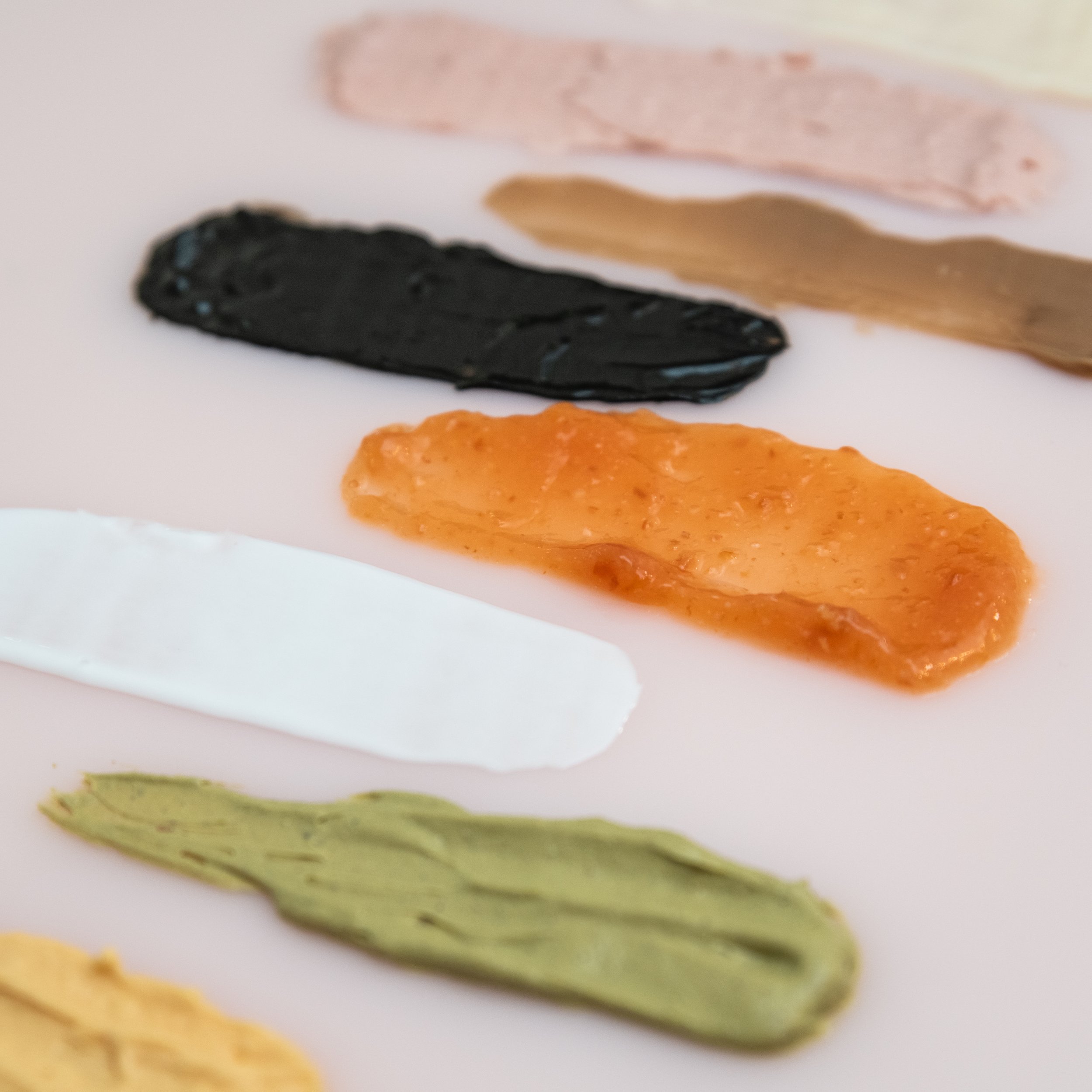
Skincare Products
If you've sat in my treatment room on E 41st Street, you've probably heard me say the word "barrier" about four hundred times. That's not an accident — it's the whole philosophy. And there's actually a name for it: corneotherapy.
I get asked about this a lot, usually by clients who've Googled "corneotherapy Austin" after seeing it listed on my About page and had no idea what they were looking at. Fair. It's not a word you run into unless you're deep in the skin-nerd trenches — which, full disclosure, I am. So let's talk about what it actually means, and why I think it's the difference between skin that just looks good for a weekend and skin that's actually healthy for the long haul.
The Short Version
Corneotherapy is a skin-science approach built around one core idea: your skin barrier — the stratum corneum, that outermost layer everyone loves to exfoliate into oblivion — isn't the enemy. It's the whole point. Instead of treating skin problems by stripping, peeling, or aggressively "fixing" the surface, corneotherapy treats the barrier as living infrastructure that needs to be repaired and protected, not demolished and rebuilt every six weeks.
I'm a member of the International Association of Applied Corneotherapy, and that membership isn't a certificate I hung on the wall and forgot about — you can see it along with the rest of my credentials and training on my About page. It's genuinely how I approach every facial, every consult, every product recommendation I make.
Why This Matters More Than It Sounds Like It Should
Here's the thing about a lot of "results-driven" skincare: it works by irritating your skin into submission. Acid peel, redness, flaking, "purging," repeat. You get a short-term glow and a long-term barrier that's thinner, more reactive, and more dependent on aggressive treatment to look normal.
Corneotherapy flips that. The barrier is where your skin holds onto hydration, keeps irritants and bacteria out, and regulates inflammation. When it's healthy, your skin does most of the work on its own — you need less intervention, not more. When it's compromised (over-exfoliated, over-actived, sunburned, or just genetically thin and reactive, which I see constantly here in Central Austin with our sun exposure), everything gets harder: breakouts, sensitivity, premature fine lines, rosacea flares. You end up chasing symptoms instead of fixing the actual problem.
This is also exactly why corneotherapy principles matter so much for anyone I see through my Oncology Esthetics work — skin that's been through chemo or radiation has a barrier that's already under real stress, and "aggressive" is the last thing it needs.
What This Looks Like in Practice
When someone comes in for a Skin Consultation or an Advanced Skin Analysis — both explained in more detail in my FAQs — I'm not just looking at what's wrong on the surface, I'm looking at whether your barrier is intact enough to handle what you're currently doing to it. Sometimes the answer is "add more actives." Just as often, the answer is "stop doing three of the things you're doing and let your skin catch its breath." That's not the answer everyone wants to hear, but it's usually the one that actually works.
It's part of why I default to gentler, barrier-respecting technology in the studio — things like LED light therapy and Topical Light Infusions instead of reaching for aggressive resurfacing every time, and why even something like microneedling gets paired with growth-factor serum and post-treatment LED rather than just poking holes and sending you home.
Corneotherapy, Austin-Style
I've been doing this in the same spot in Hyde Park — right off E 41st, across from the HEB — for over a decade now, and I've treated a lot of skin from all over Central Austin: Hyde Park regulars who walk over, North Loop folks who bike down, Ridgetop and Triangle neighbors, UT grad students and faculty who found me because I'm five minutes from campus, and clients driving in from Hancock, Brentwood, and further out because word travels. One thing I've noticed across all of it: Austin skin has its own particular set of barrier stressors. Intense UV exposure most of the year, big humidity swings between our brutal summers and dry winter cold fronts, and a whole lot of outdoor-lifestyle clients — runners on the Shoal Creek trail, cyclists, people who work from a coffee shop patio half the year. That combination is genuinely hard on the skin barrier, and it's a big part of why I lean so heavily on corneotherapy principles with the people I see here specifically. This isn't generic skincare advice — it's built around what actually happens to skin that lives outside in Central Texas.
The Bottom Line
Corneotherapy isn't a treatment you book — it's the lens I look through for every treatment I do offer. If your skin feels like it's constantly fighting you no matter how many products you throw at it, there's a decent chance the barrier is the actual issue, not whatever symptom is loudest that week.
If you want an actual look at what's going on with your skin's barrier — not a guess, an actual analysis — that's exactly what a Skin Consultation or Advanced Skin Analysis session with me is for. Book an appointment or check out studio info if you're not sure where to start. Wherever you are with your skin right now is the perfect place to start.